The Eurasian Pharma Podcast is a platform for discussing current trends in the pharmaceutical industry across the EAEU and Central Asia.
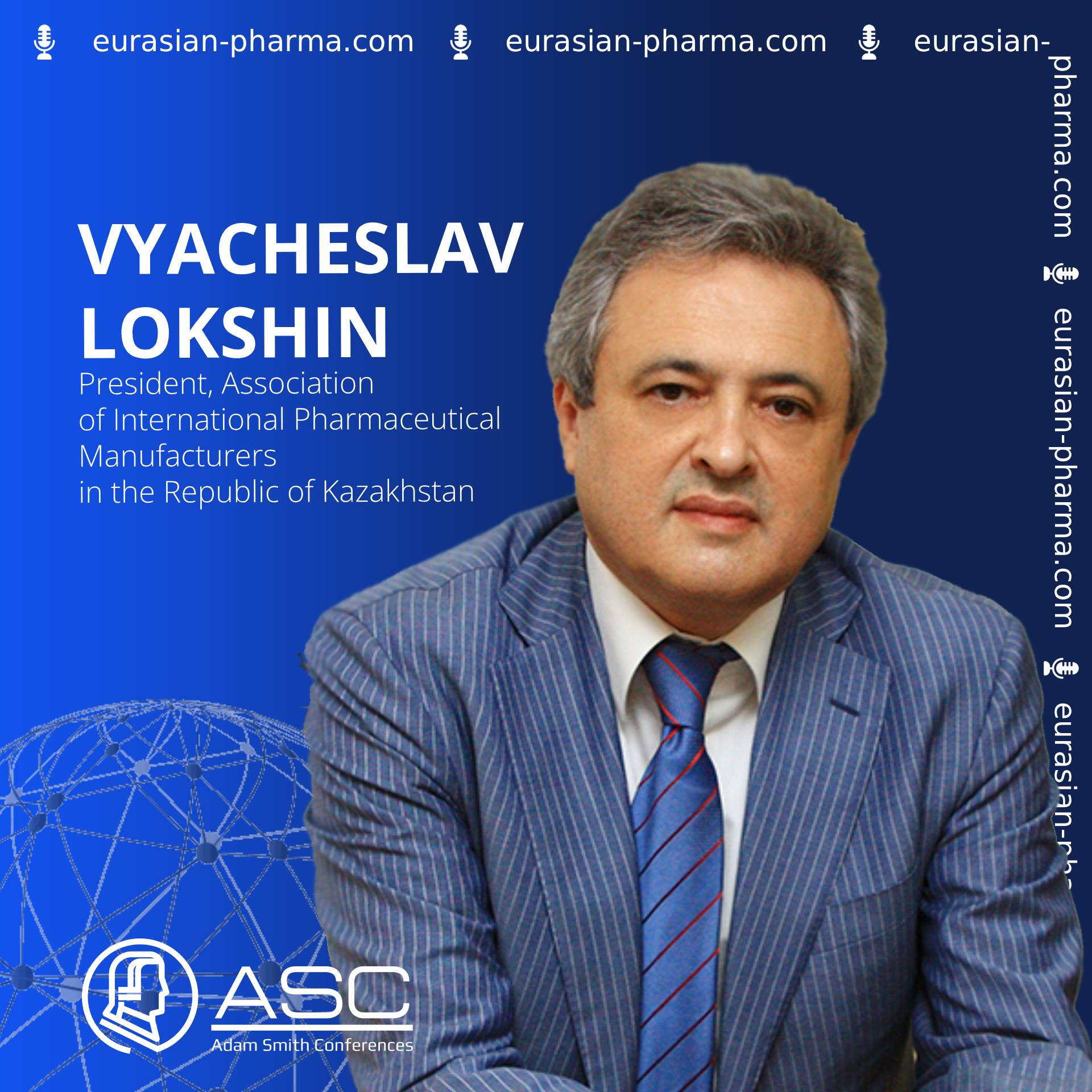
In this interview, we speak with Vyacheslav Lokshin, President of the Association of International Pharmaceutical Manufacturers in the Republic of Kazakhstan, headliner and long-time moderator of the Eurasian Pharmaceutical Forum.
In this interview, we speak with Vyacheslav Lokshin, President of the Association of International Pharmaceutical Manufacturers in the Republic of Kazakhstan, headliner and long-time moderator of the Eurasian Pharmaceutical Forum.
Listen to the podcast in Russian
— There are three months left until the end of the year, but I’d already like to discuss what key changes in the pharmaceutical markets of the EAEU and Uzbekistan you would highlight as of today.
— I should say that both Kazakhstan and other countries of the Eurasian Union — including Uzbekistan, which is still an observer in this system — continue, on the one hand, to expand the list of medicines for public procurement, and on the other, to maintain pressure on companies’ pricing policies, bringing prices down to some of the lowest levels in the world — comparable to those in Turkey, Russia, Poland, and so on.
This year, price regulation in Kazakhstan has indeed tightened significantly. Despite our objections, the Ministry of Health still found arguments to leave the regulation almost unchanged — and even to strengthen it. This time, they decided to take the average of the three lowest price indicators among the benchmark countries.
In any case, the price regulation system has become stricter, and there have even been risks that certain medicines might leave the market. We don’t yet know the exact results, because current prices are still based on old imports, but I believe that in a month or two we’ll already start seeing medicines on pharmacy shelves at lower prices.
Price regulation is, on the one hand, a positive factor for patients, but not so positive for manufacturers — as logistics costs are rising, especially under the current political instability, when companies have to reroute shipments around many countries. Naturally, logistics become more expensive. Registration and variation fees aren’t decreasing either, and there’s additional price regulation on top of that. At the same time, over-the-counter medicines have not yet been exempted from price control, as many expected.
So, I think these developments don’t contribute much to companies’ overall stability in the market.
On the other hand, Kazakhstan continues its policy of expanding compulsory social health insurance and optimizing the system. The list of reimbursable medicines hasn’t expanded yet, but we expect that more effective and safer drugs will appear, while some with weaker evidence may be excluded from procurement lists. There are also questions about how to secure funding, since this remains a challenge for the state budget. Next year, we’re expecting stricter tax regulation.
So, I’d say we have even more challenges ahead than we did this year.
This year, price regulation in Kazakhstan has indeed tightened significantly. Despite our objections, the Ministry of Health still found arguments to leave the regulation almost unchanged — and even to strengthen it. This time, they decided to take the average of the three lowest price indicators among the benchmark countries.
In any case, the price regulation system has become stricter, and there have even been risks that certain medicines might leave the market. We don’t yet know the exact results, because current prices are still based on old imports, but I believe that in a month or two we’ll already start seeing medicines on pharmacy shelves at lower prices.
Price regulation is, on the one hand, a positive factor for patients, but not so positive for manufacturers — as logistics costs are rising, especially under the current political instability, when companies have to reroute shipments around many countries. Naturally, logistics become more expensive. Registration and variation fees aren’t decreasing either, and there’s additional price regulation on top of that. At the same time, over-the-counter medicines have not yet been exempted from price control, as many expected.
So, I think these developments don’t contribute much to companies’ overall stability in the market.
On the other hand, Kazakhstan continues its policy of expanding compulsory social health insurance and optimizing the system. The list of reimbursable medicines hasn’t expanded yet, but we expect that more effective and safer drugs will appear, while some with weaker evidence may be excluded from procurement lists. There are also questions about how to secure funding, since this remains a challenge for the state budget. Next year, we’re expecting stricter tax regulation.
So, I’d say we have even more challenges ahead than we did this year.
— How is your association prepared to help companies navigate these challenges, build dialogue with the government, and survive under the new conditions?
— It’s not an easy question. From the very beginning, we’ve been in direct discussions and open dialogue with the Ministry of Health, its leadership, SK-Pharmacy, and the Center for the Registration of Medicinal Products.
On the one hand, we understand that the government is increasing funding. On the other, when we compare prices in Kazakhstan, we see that they are significantly higher than in some countries with the lowest price levels — such as Turkey, the Russian Federation, Poland, and Italy.
Manufacturers sometimes make serious, perhaps even strategic mistakes, when the price difference reaches as much as twofold compared to Turkey, for example. Everyone understands that those markets are larger and have bigger public procurement volumes, but still, parliamentarians today closely monitor medicine prices — often more so than food prices.
Of course, we try to discuss, to find solutions — at least so that pricing can follow the exchange rate. If you look at it, the US dollar has risen by more than 10% just this year. That’s also a major issue, because domestic prices in tenge remain fixed.
In general, the dialogue with the authorities is direct. But we’ll see how the situation develops once these new prices take effect and which medicines might become physically unavailable to Kazakh citizens. Then, I think, we’ll be able to continue the discussion with concrete arguments — as for now, there’s no solid evidence of such cases. The Association has reached out to manufacturers, but we haven’t yet received detailed data.
However, these processes are not new. I’ve worked in pharmaceuticals for many years, and I remember back in the early 2000s, meetings with colleagues from the UK, France, and Italy — when the refrain was, “Cut the price, cut the price.” It was all about lowering prices.
In the United States, these processes continue today. You may recall when Mr. Trump established that companies not producing medicines domestically would face a 100% import duty. So, in parallel, there’s an ongoing push for companies to localize production and invest in research and development.
I believe that by early 2026, state policy toward localization will become more stable and well-defined. Simply localizing yet another generic — a drug that’s already been on the market for 20 or 25 years — is not a solution. What’s really needed is a trigger for scientific growth: the development of new research, the emergence of original medicines in Kazakhstan, and stronger cooperation with neighboring countries such as Uzbekistan.
I’ve raised these points before — everyone wants to produce the same medicines. But why? For such small markets, it would make more sense to cooperate: for example, one country could focus on oncology, another on diabetes. These issues need to be addressed — we should open our markets and define areas of specialization.
It used to be like this under the Warsaw Pact — one country produced canned goods, another pharmaceuticals. I’m not saying we need anything that rigid, but at least a shared understanding: if we know we’re producing not just for a market of 20 million people, but for a combined market of at least 50 million, including Uzbekistan — where the share of public procurement is still quite small — then we can improve the conditions for medicine availability and enhance the profitability of these products. Absolutely.
On the one hand, we understand that the government is increasing funding. On the other, when we compare prices in Kazakhstan, we see that they are significantly higher than in some countries with the lowest price levels — such as Turkey, the Russian Federation, Poland, and Italy.
Manufacturers sometimes make serious, perhaps even strategic mistakes, when the price difference reaches as much as twofold compared to Turkey, for example. Everyone understands that those markets are larger and have bigger public procurement volumes, but still, parliamentarians today closely monitor medicine prices — often more so than food prices.
Of course, we try to discuss, to find solutions — at least so that pricing can follow the exchange rate. If you look at it, the US dollar has risen by more than 10% just this year. That’s also a major issue, because domestic prices in tenge remain fixed.
In general, the dialogue with the authorities is direct. But we’ll see how the situation develops once these new prices take effect and which medicines might become physically unavailable to Kazakh citizens. Then, I think, we’ll be able to continue the discussion with concrete arguments — as for now, there’s no solid evidence of such cases. The Association has reached out to manufacturers, but we haven’t yet received detailed data.
However, these processes are not new. I’ve worked in pharmaceuticals for many years, and I remember back in the early 2000s, meetings with colleagues from the UK, France, and Italy — when the refrain was, “Cut the price, cut the price.” It was all about lowering prices.
In the United States, these processes continue today. You may recall when Mr. Trump established that companies not producing medicines domestically would face a 100% import duty. So, in parallel, there’s an ongoing push for companies to localize production and invest in research and development.
I believe that by early 2026, state policy toward localization will become more stable and well-defined. Simply localizing yet another generic — a drug that’s already been on the market for 20 or 25 years — is not a solution. What’s really needed is a trigger for scientific growth: the development of new research, the emergence of original medicines in Kazakhstan, and stronger cooperation with neighboring countries such as Uzbekistan.
I’ve raised these points before — everyone wants to produce the same medicines. But why? For such small markets, it would make more sense to cooperate: for example, one country could focus on oncology, another on diabetes. These issues need to be addressed — we should open our markets and define areas of specialization.
It used to be like this under the Warsaw Pact — one country produced canned goods, another pharmaceuticals. I’m not saying we need anything that rigid, but at least a shared understanding: if we know we’re producing not just for a market of 20 million people, but for a combined market of at least 50 million, including Uzbekistan — where the share of public procurement is still quite small — then we can improve the conditions for medicine availability and enhance the profitability of these products. Absolutely.
— Are there any positive trends? Perhaps not dramatic ones, but still positive developments in the market?
— The positive trend is that new companies are entering the market. More representative offices are being opened, and an increasing number of companies are bringing dietary supplements to Kazakhstan.
The government is not backing away from its commitments. Moreover, the country’s leadership has announced that with the rise in taxes, additional resources will become available. VAT is also being introduced on pharmaceutical products, though an exception will apply to those supplied under public procurement.
At the same time, there’s not much optimism yet. There’s considerable dissatisfaction about alleged violations in the public procurement system, and indeed, comparisons show that prices for local drugs — generics — often significantly exceeded equivalent prices in the Russian Federation and other countries.
These are very complex issues. The market must become more transparent. For some companies that are less active in the market, price regulation is, for some reason, applied less strictly. Therefore, a process of greater openness is now underway — and that’s very important.
The government is not backing away from its commitments. Moreover, the country’s leadership has announced that with the rise in taxes, additional resources will become available. VAT is also being introduced on pharmaceutical products, though an exception will apply to those supplied under public procurement.
At the same time, there’s not much optimism yet. There’s considerable dissatisfaction about alleged violations in the public procurement system, and indeed, comparisons show that prices for local drugs — generics — often significantly exceeded equivalent prices in the Russian Federation and other countries.
These are very complex issues. The market must become more transparent. For some companies that are less active in the market, price regulation is, for some reason, applied less strictly. Therefore, a process of greater openness is now underway — and that’s very important.
— In recent years, the issue of localization has often been raised at the Eurasian Pharmaceutical Forum. In your opinion, how is the development of local production progressing in the EAEU countries and Uzbekistan today?
— The topic of localization has been discussed for a long time — since the 1990s, when the share of domestic manufacturers was no more than 2%. Of course, that figure has been significantly improved, increasing several times over. Today, local producers account for about 25–30% in volume terms, so to speak, while in monetary value the share is smaller. In public procurement, domestic manufacturers make up almost half of the total volume.
However, it must be said that most of what’s being produced are generics, and their prices are not the lowest. The ten-year contracts, in my view, haven’t brought significant results — the period is too long. Companies producing locally often have higher prices, while competitors from neighboring countries can sometimes offer the same products two and a half times cheaper. We can clearly see that.
Therefore, I believe it’s time to set conditions for domestic manufacturers to invest in research and the development of new medicines. I find it absurd that the Ministry of Science and Education is the one allocating funds for drug development. Why? This should be done by manufacturers themselves if the projects are truly promising.
I also think that too few clinical studies are being conducted in the country — including by local producers. The Ministry of Health understands this and is now negotiating with Big Pharma countries, and there have been some successes. For example, Hoffmann-La Roche and AstraZeneca have begun producing their medicines locally. They’ve started with packaging, of course, but I believe this process will go deeper.
That’s why it should be a two-way street. We’ve given the market to a few companies — yes, we’re grateful to them; they supported us during the pandemic. But now we need to talk about investing in science as well. Anyone can simply package medicines. The pandemic is over.
However, it must be said that most of what’s being produced are generics, and their prices are not the lowest. The ten-year contracts, in my view, haven’t brought significant results — the period is too long. Companies producing locally often have higher prices, while competitors from neighboring countries can sometimes offer the same products two and a half times cheaper. We can clearly see that.
Therefore, I believe it’s time to set conditions for domestic manufacturers to invest in research and the development of new medicines. I find it absurd that the Ministry of Science and Education is the one allocating funds for drug development. Why? This should be done by manufacturers themselves if the projects are truly promising.
I also think that too few clinical studies are being conducted in the country — including by local producers. The Ministry of Health understands this and is now negotiating with Big Pharma countries, and there have been some successes. For example, Hoffmann-La Roche and AstraZeneca have begun producing their medicines locally. They’ve started with packaging, of course, but I believe this process will go deeper.
That’s why it should be a two-way street. We’ve given the market to a few companies — yes, we’re grateful to them; they supported us during the pandemic. But now we need to talk about investing in science as well. Anyone can simply package medicines. The pandemic is over.
— Kazakhstan is becoming increasingly attractive for foreign investment. How appealing is the pharmaceutical sector for international investors and manufacturers today?
— I must say that investment policy is one of our government’s top priorities. The president himself emphasizes this, and indeed, all his actions are aimed at attracting additional investment into the country’s economy — particularly in the development of new mineral deposits and resource extraction projects with partners from China, France, the United States, and the Russian Federation. Major businesses are entering Kazakhstan, and there is a genuine effort to create favorable conditions for operating here — including for localizing production.
However, all this is still not enough, because our neighbors are doing the same. Uzbekistan, in particular, is now working very actively in this direction, energetically attracting new partners. So yes, investment is coming in; there are examples of new production sites being built, but we are still only at the beginning of this journey.
Unfortunately, many years were lost, and corruption consumed a great deal of potential. As a result, we now see a shift toward tighter tax regulation — taxes will increase, VAT is being introduced in areas where it didn’t exist before, such as medicine and pharmaceuticals. In a way, we are returning to what we once moved away from. There’s also stricter regulation of individual entrepreneurs.
That’s life. We live in a large, civilized world, and these processes are happening everywhere. Look at France, where taxes reach 50% or more — it’s similar in other European countries. There’s no other option but to tighten our belts a bit.
But Kazakhstan is a special country — with enormous resources and vast potential. Today, our national leadership is trying to realize that potential, including by leveraging the country’s scientific capacity.
Just last week, a meeting of the National Science and Technology Council — of which I am a member — was held under the chairmanship of President Kassym-Jomart Kemelevich Tokayev himself. Much attention was given to the development of the nuclear industry and the construction of new nuclear power plants. The first will be built by Rosatom, and two more — by Chinese and French partners. So, today, the energy sector as a whole is receiving serious focus.
Overall, Kazakhstan’s investment climate is positive.
However, all this is still not enough, because our neighbors are doing the same. Uzbekistan, in particular, is now working very actively in this direction, energetically attracting new partners. So yes, investment is coming in; there are examples of new production sites being built, but we are still only at the beginning of this journey.
Unfortunately, many years were lost, and corruption consumed a great deal of potential. As a result, we now see a shift toward tighter tax regulation — taxes will increase, VAT is being introduced in areas where it didn’t exist before, such as medicine and pharmaceuticals. In a way, we are returning to what we once moved away from. There’s also stricter regulation of individual entrepreneurs.
That’s life. We live in a large, civilized world, and these processes are happening everywhere. Look at France, where taxes reach 50% or more — it’s similar in other European countries. There’s no other option but to tighten our belts a bit.
But Kazakhstan is a special country — with enormous resources and vast potential. Today, our national leadership is trying to realize that potential, including by leveraging the country’s scientific capacity.
Just last week, a meeting of the National Science and Technology Council — of which I am a member — was held under the chairmanship of President Kassym-Jomart Kemelevich Tokayev himself. Much attention was given to the development of the nuclear industry and the construction of new nuclear power plants. The first will be built by Rosatom, and two more — by Chinese and French partners. So, today, the energy sector as a whole is receiving serious focus.
Overall, Kazakhstan’s investment climate is positive.
— Today, digital technologies and artificial intelligence are transforming many industries — including pharma. In your view, can they enhance the investment attractiveness of the pharmaceutical sector, and which technologies should companies focus on to advance clinical research and other areas?
— Artificial intelligence and digitalization have been identified as the key drivers of Kazakhstan’s future economic development.
Just a few days ago, a new Ministry of Artificial Intelligence and Digitalization was established in Kazakhstan, and its head was given the rank of Deputy Prime Minister. This shows that special attention is being paid to integrating AI into all sectors of the economy — banking, healthcare, and beyond. Work in this direction is already underway, and scientific research is being actively conducted.
I believe it will soon become much easier to carry out both scientific studies and the development of new medicines. Today, transparency in all processes is crucial — and here, the role of artificial intelligence is also significant. I’m confident that these developments will make the country more competitive overall.
Of course, we must also bring clinical research into this space. AI can be used as a tool to accelerate and enhance the quality of such studies.
Just a few days ago, a new Ministry of Artificial Intelligence and Digitalization was established in Kazakhstan, and its head was given the rank of Deputy Prime Minister. This shows that special attention is being paid to integrating AI into all sectors of the economy — banking, healthcare, and beyond. Work in this direction is already underway, and scientific research is being actively conducted.
I believe it will soon become much easier to carry out both scientific studies and the development of new medicines. Today, transparency in all processes is crucial — and here, the role of artificial intelligence is also significant. I’m confident that these developments will make the country more competitive overall.
Of course, we must also bring clinical research into this space. AI can be used as a tool to accelerate and enhance the quality of such studies.
— Let’s talk a bit about the harmonization of regulatory requirements. In your view, has there been progress in this area over the past few years?
— The harmonization process is quite complex, and we’ve been moving along this path for many years. I’ve always been one of those who strongly support harmonization, as it can help expand our shared pharmaceutical space and make it more attractive for manufacturers.
However, the process has not been easy. In December last year, I participated in negotiations between the Minister of Health of the Russian Federation, Mikhail Albertovich, and the Minister of Health of Kazakhstan, Akmaral Sharipbaevna. One of the topics discussed was precisely the issue of harmonization — namely, that mutual recognition, delays, and excessive peer review are slowing down the process.
As a result, a number of medicines have had to be transferred back into the national registration system. Unfortunately, our regulators still find it difficult to establish a common language and have not yet managed to create a unified IT system.
There are clear challenges in implementing this important political decision. The idea was to move forward, meet more often, and align our interests rather than pull in different directions. We need to find a way to distribute responsibilities and revenues fairly, regardless of which country receives the application.
In my opinion, this can be solved quite simply. The customs system already offers a model — customs duties collected at the border are distributed among the member countries. The same principle could be applied to regulatory fees.
We also need mutual trust — an understanding of how each regulator operates — and greater accountability.
But for now, challenges remain. Only a limited number of products have successfully gone through Eurasian registration. These issues must be resolved more quickly.
However, the process has not been easy. In December last year, I participated in negotiations between the Minister of Health of the Russian Federation, Mikhail Albertovich, and the Minister of Health of Kazakhstan, Akmaral Sharipbaevna. One of the topics discussed was precisely the issue of harmonization — namely, that mutual recognition, delays, and excessive peer review are slowing down the process.
As a result, a number of medicines have had to be transferred back into the national registration system. Unfortunately, our regulators still find it difficult to establish a common language and have not yet managed to create a unified IT system.
There are clear challenges in implementing this important political decision. The idea was to move forward, meet more often, and align our interests rather than pull in different directions. We need to find a way to distribute responsibilities and revenues fairly, regardless of which country receives the application.
In my opinion, this can be solved quite simply. The customs system already offers a model — customs duties collected at the border are distributed among the member countries. The same principle could be applied to regulatory fees.
We also need mutual trust — an understanding of how each regulator operates — and greater accountability.
But for now, challenges remain. Only a limited number of products have successfully gone through Eurasian registration. These issues must be resolved more quickly.
— Do I understand correctly that the main issue now lies in communication, and that the information system itself is simply not well structured yet?
— Absolutely right. But I believe that any information system can be built if there’s a political decision to do so — once the decision is made and those responsible are appointed.
This could have been done a long time ago, but progress has been very slow.
At the last Eurasian Pharmaceutical Forum, we spoke quite frankly — even sharply — about these processes and the urgent need for harmonization. It seemed to me then that the situation had started to move in the right direction, especially after my meeting with the Minister of Health of the Russian Federation.
However, it appears that the regulators did not receive enough of a push to truly begin moving closer together.
This could have been done a long time ago, but progress has been very slow.
At the last Eurasian Pharmaceutical Forum, we spoke quite frankly — even sharply — about these processes and the urgent need for harmonization. It seemed to me then that the situation had started to move in the right direction, especially after my meeting with the Minister of Health of the Russian Federation.
However, it appears that the regulators did not receive enough of a push to truly begin moving closer together.
— What do you think is missing? Are more interim meetings between forums needed?
— I think so, yes. We need more meetings and mutual decisions. The parties should simply announce that agreements have been reached — and then the process will move forward much faster. That’s what needs to happen.
Kazakhstan has already taken a step in this direction by creating a fast-track registration system for medicines that have already been approved in European countries — offered as a national composite service.
And that’s the right approach. Why overcomplicate things if a medicine is already registered internationally? We’re creating unnecessary barriers.
After all, we’re not serving political goals — we’re serving patients, people who are ill and need effective medicines. If we trust the European, American, or Japanese regulatory systems, then we should trust them fully.
I understand there’s a lot of politics involved, but the interests of patients must always come first.
Kazakhstan has already taken a step in this direction by creating a fast-track registration system for medicines that have already been approved in European countries — offered as a national composite service.
And that’s the right approach. Why overcomplicate things if a medicine is already registered internationally? We’re creating unnecessary barriers.
After all, we’re not serving political goals — we’re serving patients, people who are ill and need effective medicines. If we trust the European, American, or Japanese regulatory systems, then we should trust them fully.
I understand there’s a lot of politics involved, but the interests of patients must always come first.
— In your view, what three factors will define the competitiveness of pharmaceutical companies in the EAEU and Uzbekistan in the coming years?
— I believe the first is speed of decision-making.
Then, resolving the issues of localization and launching clinical research within our countries.
And, of course, pricing policy will remain a key factor. I think companies shouldn’t be too rigid when it comes to pricing. If you decide to enter the Turkish market with a significantly lower price, then be ready to offer a similar price elsewhere. No one has extra budget — and in that sense, the regulators and the Ministry of Health are doing the right thing. Their budgets are also limited. Lawmakers see the same price lists, so we must either explain why our prices differ from one country to another, or decide what’s more important — maintaining physical market presence or holding the price.
But I believe most manufacturers are open to dialogue. No one has refused to engage or compromise — and that’s crucial. If we reach an understanding, our products will stay on the market. If not, some companies will leave — and lose significant revenue here.
Looking ahead, Kazakhstan sets a strong example: already today, nearly 45% of the national pharmaceutical market is represented by state-funded medicines through the Compulsory Social Health Insurance Fund.
Then, resolving the issues of localization and launching clinical research within our countries.
And, of course, pricing policy will remain a key factor. I think companies shouldn’t be too rigid when it comes to pricing. If you decide to enter the Turkish market with a significantly lower price, then be ready to offer a similar price elsewhere. No one has extra budget — and in that sense, the regulators and the Ministry of Health are doing the right thing. Their budgets are also limited. Lawmakers see the same price lists, so we must either explain why our prices differ from one country to another, or decide what’s more important — maintaining physical market presence or holding the price.
But I believe most manufacturers are open to dialogue. No one has refused to engage or compromise — and that’s crucial. If we reach an understanding, our products will stay on the market. If not, some companies will leave — and lose significant revenue here.
Looking ahead, Kazakhstan sets a strong example: already today, nearly 45% of the national pharmaceutical market is represented by state-funded medicines through the Compulsory Social Health Insurance Fund.
— Vyacheslav, what are the long-term goals your Association has set for the coming years?
— We see ourselves as a partner of the state and as an organization that protects the interests of international manufacturers operating in our country.
We are committed to building a transparent and civilized open market, where the government plays an active role in the procurement of medicines.
Our main goal is to ensure that patients have access to high-quality, effective, and safe medicines at affordable prices.
Fulfilling this mission on behalf of our members — the world’s leading pharmaceutical companies — is, I believe, the key objective that defines our work and our long-term vision in Kazakhstan.
We are committed to building a transparent and civilized open market, where the government plays an active role in the procurement of medicines.
Our main goal is to ensure that patients have access to high-quality, effective, and safe medicines at affordable prices.
Fulfilling this mission on behalf of our members — the world’s leading pharmaceutical companies — is, I believe, the key objective that defines our work and our long-term vision in Kazakhstan.
— I’m confident that many of the issues you’ve raised today will be discussed — and, I hope, resolved — at the Eurasian Pharmaceutical Forum, which will take place on January 26–28, 2026.
Vyacheslav, thank you for this insightful and engaging conversation!
Vyacheslav, thank you for this insightful and engaging conversation!