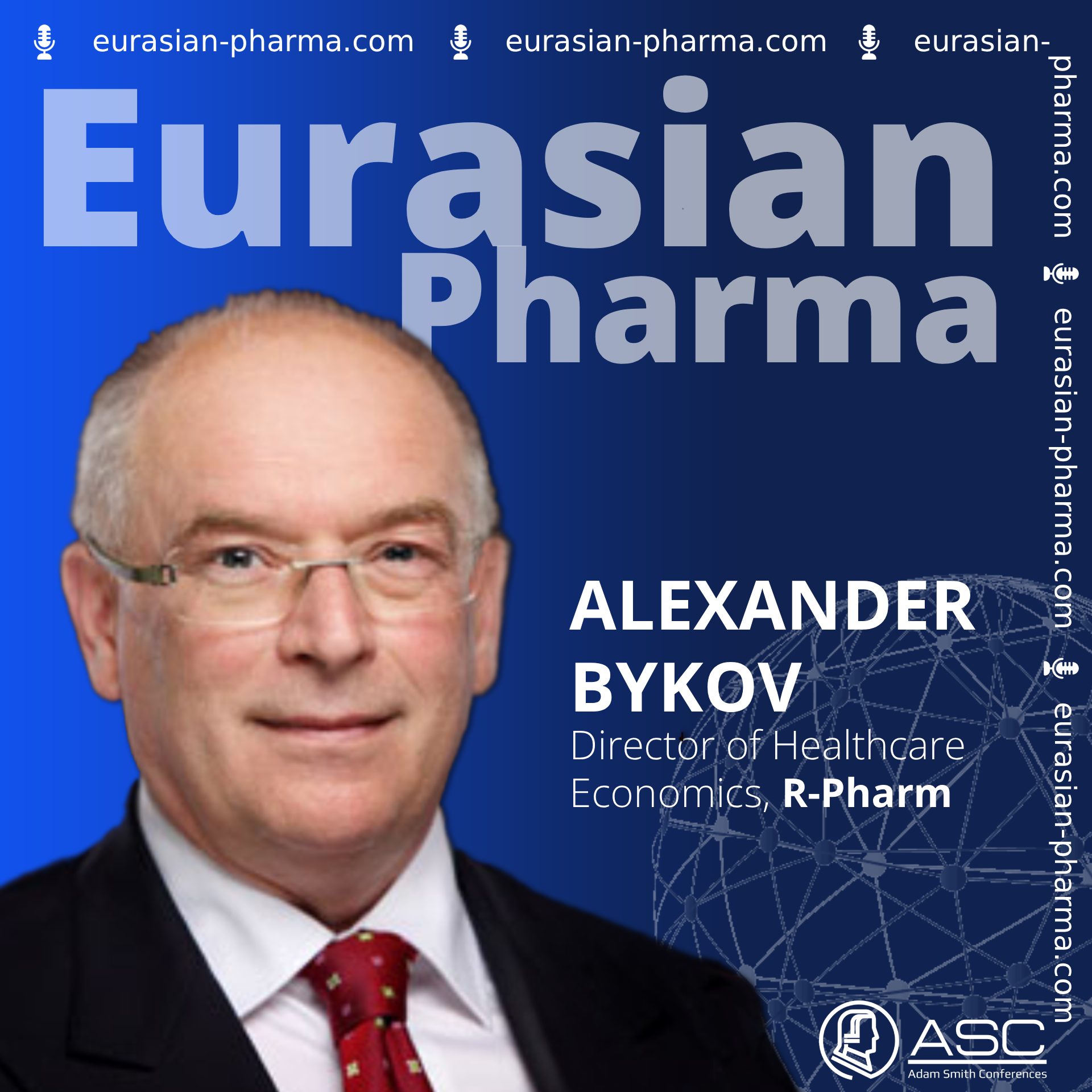
Alexander Bykov, Director of Healthcare Economics at R-Pharm, spoke about the strategic priorities in the development of the pharmaceutical industry. The interview covers the role of innovation and technology in transforming healthcare, the advancement of proprietary molecular developments, the use of artificial intelligence, and new approaches to international cooperation.
It also discusses the prospects for digitalizing logistics, drug labeling, the creation of a unified pharmaceutical space within the EAEU, and the importance of personalized medicine as a key direction for the future.
It also discusses the prospects for digitalizing logistics, drug labeling, the creation of a unified pharmaceutical space within the EAEU, and the importance of personalized medicine as a key direction for the future.
Listen in Russian: 🎙️YouTube
Alexander, let’s take a look into the future and talk about what the next 5 to 10 years might bring. What kind of innovation strategy is R-Pharm pursuing today?
R-Pharm is a leading Russian pharmaceutical company whose core strategy is built around the motto: making innovation accessible to healthcare. Naturally, the company’s main development focus is on ensuring that the most advanced achievements in pharmaceutical science, medical devices, and healthcare technologies are not only developed with our participation, but also implemented as quickly as possible—so that patients and the healthcare system can gain earlier access to these innovations.
Is R-Pharm focusing on its own molecular developments, licensing, or international collaborations?
You know, I’d say all three components are important here. At a certain point, in order to diversify and drive the development of the company, science, and research, it’s essential to advance all three directions. Developing both generic chemical-formulary and biological drugs provides a necessary foundation—economic, financial, resource-based, intellectual, and technological—which then enables us to work on cutting-edge molecules that will target the diseases shaping the healthcare landscape 5 to 10 years from now.
All of these elements are crucial. Collaboration and partnerships with international partners—leading research institutes and centers both in Russia and abroad, in friendly countries, and with labs that are open and willing to cooperate—also provide a valuable resource for building expertise.
We believe that the company’s sustainable growth rests precisely on these three pillars. But beyond the development of innovative molecules, a very important aspect is participating in sustainability projects—so that these innovations either have a neutral impact or help minimize negative effects on the environment.
In short, pursuing the most advanced directions is key to the company’s success and a stable, future-oriented vision.
All of these elements are crucial. Collaboration and partnerships with international partners—leading research institutes and centers both in Russia and abroad, in friendly countries, and with labs that are open and willing to cooperate—also provide a valuable resource for building expertise.
We believe that the company’s sustainable growth rests precisely on these three pillars. But beyond the development of innovative molecules, a very important aspect is participating in sustainability projects—so that these innovations either have a neutral impact or help minimize negative effects on the environment.
In short, pursuing the most advanced directions is key to the company’s success and a stable, future-oriented vision.
Shall we talk in more detail about molecular development? Which areas does R-Pharm consider a priority for the next 10 years, and why?
I’d like to highlight that in 2024, R-Pharm launched an innovative drug on the Russian market for the treatment of a serious heart condition.
This drug is, in fact, one of the best in its class for treating autoinflammatory pericardial disease. It has already received patent protection in 59 countries, which clearly demonstrates how important the development of proprietary innovations is for the company.
In the past, drug development used to take 10 to 15 years, involving complex stages from target and molecule discovery to laboratory and clinical trials. It’s a highly costly and labor-intensive process requiring broad collaboration. Today, R-Pharm is one of the pioneers in integrating artificial intelligence technologies to shorten the preclinical phase, use AI for molecule and target screening, reduce research costs, and assess the impact on excretory target organs.
These AI technologies allow us to bring new molecules to market faster, more efficiently, and in a more economically balanced way.
Looking ahead, we’re focused on diseases typical of modern, industrialized countries—neurodegenerative disorders, oncology, autoimmune and autoinflammatory conditions. These are expected to dominate the disease landscape over the next few decades. And we’re ready. We're conducting research with these goals in mind, supported by technologies deeply integrated into our R&D processes.
Of course, we’re not doing this alone. Our collaborations include leading research institutes, and we’ve formed strong partnerships with major Russian centers like Sber. We value this partnership greatly—it creates a win-win situation that benefits everyone involved.
This drug is, in fact, one of the best in its class for treating autoinflammatory pericardial disease. It has already received patent protection in 59 countries, which clearly demonstrates how important the development of proprietary innovations is for the company.
In the past, drug development used to take 10 to 15 years, involving complex stages from target and molecule discovery to laboratory and clinical trials. It’s a highly costly and labor-intensive process requiring broad collaboration. Today, R-Pharm is one of the pioneers in integrating artificial intelligence technologies to shorten the preclinical phase, use AI for molecule and target screening, reduce research costs, and assess the impact on excretory target organs.
These AI technologies allow us to bring new molecules to market faster, more efficiently, and in a more economically balanced way.
Looking ahead, we’re focused on diseases typical of modern, industrialized countries—neurodegenerative disorders, oncology, autoimmune and autoinflammatory conditions. These are expected to dominate the disease landscape over the next few decades. And we’re ready. We're conducting research with these goals in mind, supported by technologies deeply integrated into our R&D processes.
Of course, we’re not doing this alone. Our collaborations include leading research institutes, and we’ve formed strong partnerships with major Russian centers like Sber. We value this partnership greatly—it creates a win-win situation that benefits everyone involved.
R-Pharm already has projects involving the use of AI. Could you share some examples of these projects—perhaps with figures, performance indicators, or key takeaways?
We have a joint project with Sber called Molecule Lab, which enables the screening of millions of chemical compounds with potential effects on specific targets—such as enzymes, receptors, and intricate chemical and biological processes within cells. What used to take several years can now be accomplished in just a few months.
Similarly, by building models that simulate interactions with target organs—like the kidneys or pathological cells—we can accelerate and predict excretion processes based on variables like age or the presence of comorbidities.
In other words, we’re able to model all of this digitally, significantly reducing the time required to identify a viable molecule for the preclinical research phase.
Similarly, by building models that simulate interactions with target organs—like the kidneys or pathological cells—we can accelerate and predict excretion processes based on variables like age or the presence of comorbidities.
In other words, we’re able to model all of this digitally, significantly reducing the time required to identify a viable molecule for the preclinical research phase.
So it turns out that it’s not just artificial intelligence, but a combination of technologies: data science, digital modeling, and everything together?
Absolutely. And above all, it’s aimed at providing a more accurate characterization of the substances that will eventually enter clinical trials. In this context, it’s crucial that each tablet has a flawless digital lineage—so its journey can be traced from its origin to the laboratory that will continue its study.
In a sense, you could say that blockchain in pharma isn’t about cryptocurrency, but about cryptographic protection—protection of research, of life, and of results.
To some extent, even intuition—which has long played a role in discovering new treatment approaches for cardiovascular diseases and inflammatory conditions—is now, with the integration of AI, becoming an algorithm.
And in 2025, as we’re already seeing, artificial intelligence is no longer just an assistant in the lab—it’s becoming a strategist in developing the medicines of the future.
In a sense, you could say that blockchain in pharma isn’t about cryptocurrency, but about cryptographic protection—protection of research, of life, and of results.
To some extent, even intuition—which has long played a role in discovering new treatment approaches for cardiovascular diseases and inflammatory conditions—is now, with the integration of AI, becoming an algorithm.
And in 2025, as we’re already seeing, artificial intelligence is no longer just an assistant in the lab—it’s becoming a strategist in developing the medicines of the future.
Technology involves significant investment, and all of it is protected by intellectual property. But speaking of collaborations—how accessible are your technologies to other companies?
It’s worth noting that 2025 has become a revolutionary year for the development of pharmaceutical science, the pharma industry, and drug provision in Russia. Starting this year, several national projects have come into effect.
One of these national projects is called “Long and Active Life,” which sets a goal for the entire Russian social sector—including scientists and healthcare administrators—to increase life expectancy by 2030.
There’s also the national project “New Technologies for Health Preservation,” which tasks the pharmaceutical industry with producing new, innovative, and targeted medicines that will ensure the sustainable development of pharmaceutical science in the country.
So R-Pharm is not the only company working in this direction—we’re seeing success from other companies as well. Each has its own developments, using approaches such as CAR-T and mRNA technologies to deliver chemical or biological agents directly to their targets, as well as radiopharmaceuticals. These are the areas where competencies are most advanced.
In a way, we each represent pieces of a larger puzzle—a beautiful picture that’s shaping the pharmaceutical landscape of Russia.
One of these national projects is called “Long and Active Life,” which sets a goal for the entire Russian social sector—including scientists and healthcare administrators—to increase life expectancy by 2030.
There’s also the national project “New Technologies for Health Preservation,” which tasks the pharmaceutical industry with producing new, innovative, and targeted medicines that will ensure the sustainable development of pharmaceutical science in the country.
So R-Pharm is not the only company working in this direction—we’re seeing success from other companies as well. Each has its own developments, using approaches such as CAR-T and mRNA technologies to deliver chemical or biological agents directly to their targets, as well as radiopharmaceuticals. These are the areas where competencies are most advanced.
In a way, we each represent pieces of a larger puzzle—a beautiful picture that’s shaping the pharmaceutical landscape of Russia.
Let’s take a broader view. What barriers and challenges do you see in implementing the technologies you’ve mentioned and in introducing innovative drugs, particularly when it comes to expansion within the EAEU?
The main goal—the mission—of developing the pharmaceutical industry within the EAEU platform, territory, and space is the creation of a common market. And we can already see the harmonization of regulatory requirements among the countries that form the core of the EAEU.
In this context, medicines being developed are a very clear example. Just like viruses and bacteria don’t recognize borders and can easily spread, the COVID-19 pandemic that swept across the entire region a few years ago—including the EAEU—demonstrated that without harmonizing regulatory requirements and approaches to registration, it will be very difficult to establish a unified market.
Right now, regulatory frameworks are being created that, at least in the Russian Federation, consider drugs developed and produced within the EAEU as domestic. This is laying the foundation for a shared market. But I’d also like to emphasize that rapid digitalization and the adoption of AI and big data technologies make it possible for us not to be limited to a single country or site. Scientists can be located in different centers—Moscow, Almaty, Bishkek, Minsk, Yerevan—and still form cohesive teams and work together as one well-coordinated unit. This is exactly what R&D powered by digital and AI technologies enables: collaborative, accelerated development of new molecules.
No individual country can tackle all aspects of drug development alone. While creating a drug is a critical part of the technological process, making it accessible to the population is just as important. And for that, we need harmonized regulatory practices.
When medicines can be registered under unified requirements in Moscow and other EAEU countries, it will help build a stable regulatory system—without which drug development, production, and distribution would be impossible.
We’re seeing that the regulatory approaches currently being developed within the EAEU are, in fact, shaping new standards—so-called good regulatory practices—that bring our regulatory policies closer to the world’s best.
And I hope that at some point, the World Health Organization will recognize the EAEU's regulatory system as equivalent to ICH standards and those of countries with well-established regulatory frameworks.
In this context, medicines being developed are a very clear example. Just like viruses and bacteria don’t recognize borders and can easily spread, the COVID-19 pandemic that swept across the entire region a few years ago—including the EAEU—demonstrated that without harmonizing regulatory requirements and approaches to registration, it will be very difficult to establish a unified market.
Right now, regulatory frameworks are being created that, at least in the Russian Federation, consider drugs developed and produced within the EAEU as domestic. This is laying the foundation for a shared market. But I’d also like to emphasize that rapid digitalization and the adoption of AI and big data technologies make it possible for us not to be limited to a single country or site. Scientists can be located in different centers—Moscow, Almaty, Bishkek, Minsk, Yerevan—and still form cohesive teams and work together as one well-coordinated unit. This is exactly what R&D powered by digital and AI technologies enables: collaborative, accelerated development of new molecules.
No individual country can tackle all aspects of drug development alone. While creating a drug is a critical part of the technological process, making it accessible to the population is just as important. And for that, we need harmonized regulatory practices.
When medicines can be registered under unified requirements in Moscow and other EAEU countries, it will help build a stable regulatory system—without which drug development, production, and distribution would be impossible.
We’re seeing that the regulatory approaches currently being developed within the EAEU are, in fact, shaping new standards—so-called good regulatory practices—that bring our regulatory policies closer to the world’s best.
And I hope that at some point, the World Health Organization will recognize the EAEU's regulatory system as equivalent to ICH standards and those of countries with well-established regulatory frameworks.
Indeed, it’s not only important to develop medicines, but also to ensure their delivery. What role will supply chain transparency and product labeling play in the future of innovation?
Global crises have taught us that resilience must be unconditional—it's vital. The implementation of end-to-end tracking technologies through digital tools like blockchain, digitalization, and the Internet of Things—including labeling—makes it possible to trace and provide full transparency across the entire supply chain, not only for finished pharmaceutical products.
Right now, a pilot project is underway, and starting from September 1, 2025, we will begin evaluating the first results of tracking the movement of ingredients, raw materials, intermediates, and chemical and pharmaceutical components of active pharmaceutical substances—from the very beginning of development all the way to the end consumer.
This is crucial because we often face situations where a company is ready to bring chemical raw materials or innovative biological developments to market but struggles to find a partner. In this sense, an innovation exchange that brings together developers and buyers helps quickly and cost-effectively establish partnerships.
On the other hand, with the implementation of digital technologies, it becomes possible to deliver medicines more efficiently. For instance, through this exchange platform, one could connect with certified transport or logistics companies and arrange lower-cost deliveries not only within the country but also internationally. These companies could handle all customs documentation, and digitalization would reduce the time needed for customs processing. In this way, digitalization opens up truly revolutionary possibilities for logistics.
As for labeling, the results we’re seeing today show that it allows us to accurately track the exact quantity and location of a drug—right down to a specific pharmacy and region. This helps identify shortages or, conversely, confirm that there are sufficient stocks in warehouses, which allows production and distribution to continue calmly and efficiently.
In essence, labeling acts as the nervous system—or perhaps even the neurotransmitters—of the pharmaceutical supply chain.
Right now, a pilot project is underway, and starting from September 1, 2025, we will begin evaluating the first results of tracking the movement of ingredients, raw materials, intermediates, and chemical and pharmaceutical components of active pharmaceutical substances—from the very beginning of development all the way to the end consumer.
This is crucial because we often face situations where a company is ready to bring chemical raw materials or innovative biological developments to market but struggles to find a partner. In this sense, an innovation exchange that brings together developers and buyers helps quickly and cost-effectively establish partnerships.
On the other hand, with the implementation of digital technologies, it becomes possible to deliver medicines more efficiently. For instance, through this exchange platform, one could connect with certified transport or logistics companies and arrange lower-cost deliveries not only within the country but also internationally. These companies could handle all customs documentation, and digitalization would reduce the time needed for customs processing. In this way, digitalization opens up truly revolutionary possibilities for logistics.
As for labeling, the results we’re seeing today show that it allows us to accurately track the exact quantity and location of a drug—right down to a specific pharmacy and region. This helps identify shortages or, conversely, confirm that there are sufficient stocks in warehouses, which allows production and distribution to continue calmly and efficiently.
In essence, labeling acts as the nervous system—or perhaps even the neurotransmitters—of the pharmaceutical supply chain.
Will the pharmaceutical business in 5 to 10 years resemble the tech industry more closely?
You know, I’d even say it might start to resemble something like a pharmaceutical Tinder. We’ll be able to form partnerships, create strong alliances and collaborations that ensure the accessibility of medicines.
At the same time, of course, we must not forget that the main threat, oddly enough, may not only be new diseases that could emerge. The World Health Organization, the World Health Assembly, and the UN have all emphasized that resistant strains of microorganisms and bacteria could pose a serious challenge to healthcare systems.
The development of new antibiotics is another area where artificial intelligence can help us. On the one hand, it can predict which tools, technologies, or factors might lead to microbial resistance. On the other hand, it can help design new antibiotics that are capable of overcoming this resistance.
In essence, new technologies will shape the future of healthcare. And it’s crucial that the EAEU—and partnerships beyond it—are fully integrated into the global pharmaceutical agenda, industry, regulatory environment, and R&D landscape, so we remain part of the global context.
This is also important from the standpoint that even when medicines are exported within the EAEU, it already significantly raises the bar for resilience and development quality. And if those products reach broader international markets, it will drive further harmonization of requirements and ensure that pharmaceutical products are of the highest quality.
They’re already high-quality, of course—but in practice, an export-oriented approach typically goes hand-in-hand with meeting the highest standards.
At the same time, of course, we must not forget that the main threat, oddly enough, may not only be new diseases that could emerge. The World Health Organization, the World Health Assembly, and the UN have all emphasized that resistant strains of microorganisms and bacteria could pose a serious challenge to healthcare systems.
The development of new antibiotics is another area where artificial intelligence can help us. On the one hand, it can predict which tools, technologies, or factors might lead to microbial resistance. On the other hand, it can help design new antibiotics that are capable of overcoming this resistance.
In essence, new technologies will shape the future of healthcare. And it’s crucial that the EAEU—and partnerships beyond it—are fully integrated into the global pharmaceutical agenda, industry, regulatory environment, and R&D landscape, so we remain part of the global context.
This is also important from the standpoint that even when medicines are exported within the EAEU, it already significantly raises the bar for resilience and development quality. And if those products reach broader international markets, it will drive further harmonization of requirements and ensure that pharmaceutical products are of the highest quality.
They’re already high-quality, of course—but in practice, an export-oriented approach typically goes hand-in-hand with meeting the highest standards.
I think this has been a truly inspiring conversation—one that gives many companies something to reflect on as they look toward the future.
I’d like to conclude with this question: is there a particular innovation at your company that you’re especially proud of right now? Is there a project that has become a symbol of this new phase in R-Pharm’s innovation strategy?
I’d like to conclude with this question: is there a particular innovation at your company that you’re especially proud of right now? Is there a project that has become a symbol of this new phase in R-Pharm’s innovation strategy?
I’m especially proud that R-Pharm is, in many ways, both a pioneer and a driving force behind a new direction—personalized pharmaceuticals and personalized medicine.
We are currently implementing a new direction within the company: compound pharmacy, where, based on an individual’s metabolic characteristics and using omics-based diagnostic technologies—genomics, proteomics, metabolomics—we can select medications tailored to each patient. These aren’t just aimed at treating or minimizing the symptoms of a current condition, but also at preventing the development of disease in the near or even distant future, ultimately helping to extend not just life, but a high-quality, active life.
This direction is already being realized. We have “R-Pharm Compound,” where medications are prepared in pharmacy settings according to doctors’ prescriptions. But we’re going further. We’re working on localized production for orphan patients—those with rare diseases. These medications, especially solid dosage forms and peptides, can be produced right here in Russia and made available to patients not only in Russia, but also beyond.
I’m very proud of this project—it’s ambitious and requires the training of a new generation of specialists, not only in chemistry and pharmacy schools, but also in medical universities.
I’m also pleased and proud that, by the end of 2025, R-Pharm was recognized as a leader in ESG approaches in the pharmaceutical industry, and we received a corresponding award.
Our contributions to environmental safety—efforts to reduce production costs, minimize our carbon footprint, increase productivity and energy efficiency, reuse resources, and use recyclable packaging to avoid polluting the environment—are all being implemented. And we’re seeing that society values these efforts.
We are currently implementing a new direction within the company: compound pharmacy, where, based on an individual’s metabolic characteristics and using omics-based diagnostic technologies—genomics, proteomics, metabolomics—we can select medications tailored to each patient. These aren’t just aimed at treating or minimizing the symptoms of a current condition, but also at preventing the development of disease in the near or even distant future, ultimately helping to extend not just life, but a high-quality, active life.
This direction is already being realized. We have “R-Pharm Compound,” where medications are prepared in pharmacy settings according to doctors’ prescriptions. But we’re going further. We’re working on localized production for orphan patients—those with rare diseases. These medications, especially solid dosage forms and peptides, can be produced right here in Russia and made available to patients not only in Russia, but also beyond.
I’m very proud of this project—it’s ambitious and requires the training of a new generation of specialists, not only in chemistry and pharmacy schools, but also in medical universities.
I’m also pleased and proud that, by the end of 2025, R-Pharm was recognized as a leader in ESG approaches in the pharmaceutical industry, and we received a corresponding award.
Our contributions to environmental safety—efforts to reduce production costs, minimize our carbon footprint, increase productivity and energy efficiency, reuse resources, and use recyclable packaging to avoid polluting the environment—are all being implemented. And we’re seeing that society values these efforts.
Это очень здорово, потому что именно такие амбициозные проекты меняют мир.
Александр, что вы хотели бы обсудить со своими коллегами на Евразийском фармацевтическом форуме 2026?
Александр, что вы хотели бы обсудить со своими коллегами на Евразийском фармацевтическом форуме 2026?
First and foremost, I’d like to discuss horizon scanning and gain a clearer understanding of what geographical or other group-specific patterns may shape the development of certain diseases—and how we can collectively prepare to address them.
Secondly, how can we improve and optimize funding—funding for drug development, production, and procurement—so that equity is ensured, and every patient has a guaranteed opportunity to receive the necessary medication without having to navigate layers of bureaucratic hurdles and various approval committees? We want drug accessibility to align with the best global standards and to leverage the models now increasingly adopted in industrially developed countries—such as innovative procurement models, risk-sharing, and payment-by-outcome approaches, where we pay for the actual result of treatment. This also includes frameworks that protect, uphold, and advance intellectual property rights. These are all important and valuable topics to discuss with colleagues and hear the perspectives of our partners.
And what I’d like to say on my part is how great it is that all of these topics have already been included in the program for the Eurasian Pharmaceutical Forum 2026, and we’ll have the opportunity to discuss them there.
Secondly, how can we improve and optimize funding—funding for drug development, production, and procurement—so that equity is ensured, and every patient has a guaranteed opportunity to receive the necessary medication without having to navigate layers of bureaucratic hurdles and various approval committees? We want drug accessibility to align with the best global standards and to leverage the models now increasingly adopted in industrially developed countries—such as innovative procurement models, risk-sharing, and payment-by-outcome approaches, where we pay for the actual result of treatment. This also includes frameworks that protect, uphold, and advance intellectual property rights. These are all important and valuable topics to discuss with colleagues and hear the perspectives of our partners.
And what I’d like to say on my part is how great it is that all of these topics have already been included in the program for the Eurasian Pharmaceutical Forum 2026, and we’ll have the opportunity to discuss them there.
Thank you for the insightful conversation.